Most knee trouble doesn't announce itself on the footy field. It turns up on the walk from the car park, on the stairs at work, or an hour into a coastal track when the path tips downhill and every step starts to bite. If that sounds like your knees, a knee support for walking and everyday life can be a practical piece of the puzzle, alongside the strength work and pacing a physio would recommend.
This guide is the hub for our Walking and Everyday series. It covers what a soft knee brace does on a flat footpath compared with a steep bush track, how to wear one through a long shift, a long flight, a morning in the garden or a drive up the coast, and how a dial-adjustable design fits an ordinary day. Each section points to a deeper article on the situation that matches your knees.
Why everyday walking is where sore knees show up first
Walking looks gentle, but each step sends a load well above your body weight through the knee, thousands of times a day. Over a week that adds up to far more than a single gym session, which is why people with early arthritis or a grumbling kneecap often feel fine on the bike and sore after a lap of the shops.
The usual culprits are patellofemoral pain (the kneecap tracking unevenly in its groove), early osteoarthritis, and tired hip and thigh muscles that let the knee drift inwards as you load it. Our pillar on knee pain causes, symptoms and what helps covers each one, and if you're past fifty the practical guide to arthritis and ageing knees is the better place to start.
A soft support helps in two ways. Gentle compression improves the joint's sense of where it is in space, which tends to make a sore knee feel steadier, and warmth keeps stiff tissue moving more freely. Neither replaces strengthening, but both can take the edge off enough to keep you walking. Our daily comfort guide to knee support for walking covers wear time, hot-weather use and what to expect in the first fortnight.
Dog owners get a special mention, because lead-pulling, sudden stops and uneven nature strips add twisting loads a footpath never does. We cover pacing and lead technique in dog walking and daily steps with sore knees.
Bushwalking, hills and the downhill problem
Flat walking and bushwalking load the knee in different ways. On a track the ground is uneven, you're carrying a pack, and the joint works through a much bigger range of bend over roots, rock steps and creek crossings. Most walkers cope with the climb. It's the descent that hurts.
Going downhill, your quads act as brakes, lengthening under load with every step to stop you pitching forward. The kneecap is pressed hard against the thigh bone at exactly that moment, which is why the front of the knee flares on the way down. Our article on why knees hurt on downhill hikes explains the mechanics and the fixes: shorter steps, poles, a slight zigzag on steep pitches and not rushing the last kilometre.
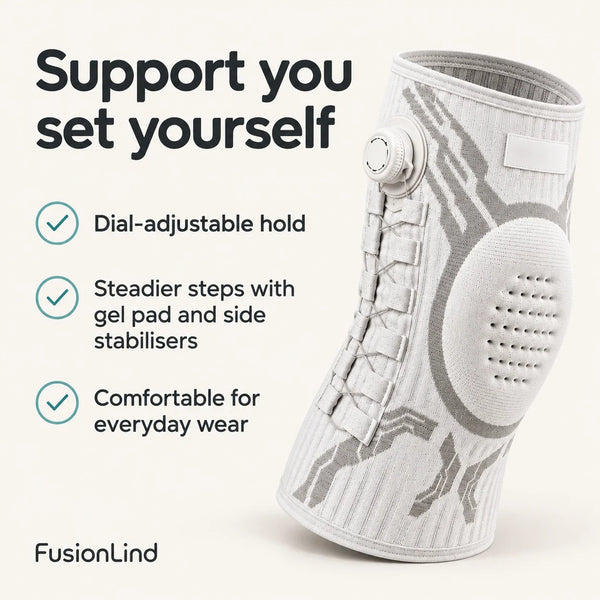
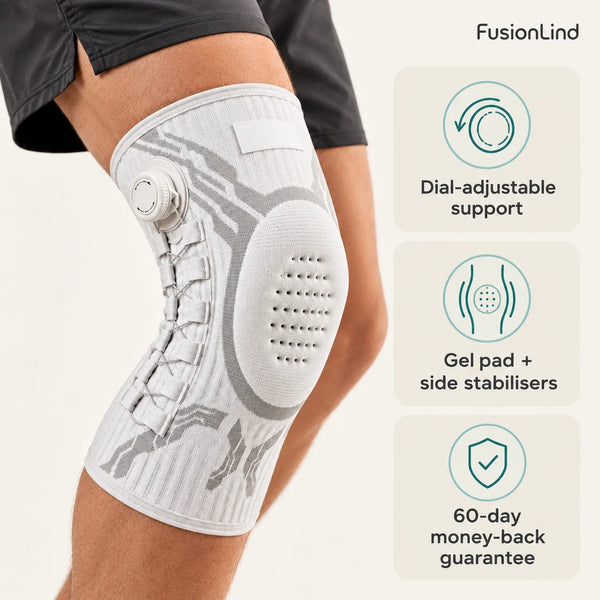
A support earns its place on these days. The kneecap gel pad in the FusionLind design helps spread pressure around the patella rather than concentrating it in one spot, and the flexible side stabilisers add a sense of security on sideways steps without the bulk of a hinged brace. Turn the dial a touch firmer for the descent and back it off on the flat.
For trail-specific advice, sweat and heat management, and what to pack for a day walk or a week on the Overland Track, read our guide to knee support for hiking and bushwalking in Australia. Trail runners should start with the Australian guide to knee support for sport.

Knees at work: standing, kneeling and long shifts
A knee that's fine on a Sunday walk can ache by Wednesday afternoon at work. Standing still on concrete is harder on the joint than walking, because the muscles never get the pumping action that moves fluid through the knee. Retail staff, hospo workers, warehouse pickers and teachers all know the feeling.
Our piece on knee support for standing all day at work covers footwear, anti-fatigue mats, small movements at a counter, and how a non-slip silicone grip keeps a support up under work trousers through a full shift. The grip matters more than people expect. A knee brace that rolls down by morning tea gets taken off and forgotten.
Tradies have a different problem: kneeling on tiles, climbing ladders, lifting from the floor and getting up off the ground dozens of times a day. The front of the knee takes a beating and the joint is constantly loaded at deep angles. Read our guide to knee support for tradies, kneeling, lifting and ladders for pairing a support with knee pads and fit under workwear.
Nurses and healthcare workers face long shifts, fast corridors and awkward patient transfers. We've written specific advice for nurses and healthcare workers wearing a knee support. If your knee pain started with a specific incident rather than creeping in, read the knee injury recovery and rehab guide and see a physio before relying on a support.
Travel, driving and the garden
Three everyday situations catch knees out because the joint is held bent and still for a long time. Sit through a flight to Perth or a drive up the coast and the knee stiffens, fluid pools and the first few steps afterwards feel borrowed. Physios call it the movie-goer's sign, and it's common with kneecap pain and early arthritis.
On long flights the fix is movement: ankle pumps, a walk down the aisle every hour or so, and a support set to a light hold to keep the joint warm and gently compressed. Our guide to knee support for travel and long flights covers security screening, cabin swelling and when to loosen the dial. Never sit for hours with a support cranked up tight.
Driving loads the right knee in particular, because it hovers over the accelerator with the thigh muscles switched on for the whole trip. Seat position, cruise control and a planned stop every couple of hours make the biggest difference. The detail is in knee pain when driving: causes and simple fixes.
Gardening is the opposite problem: lots of kneeling, squatting and getting up from the ground. A kneeling pad, raised beds and a support worn over the kneecap rather than under a knee pad all help. Our article on gardening with knee pain gives a session plan for a Saturday morning in the beds.
Footwear, fit and how a dial support fits a normal day
No support works well on bad shoes. Worn-out soles, a heel collapsed to one side or nothing under the arch changes how the whole leg lines up, and the knee pays for it. Before you buy anything for your knee, flip your everyday shoes over and check the wear pattern. Our guide to the best shoes for knee pain explains what to look for and when to replace them.
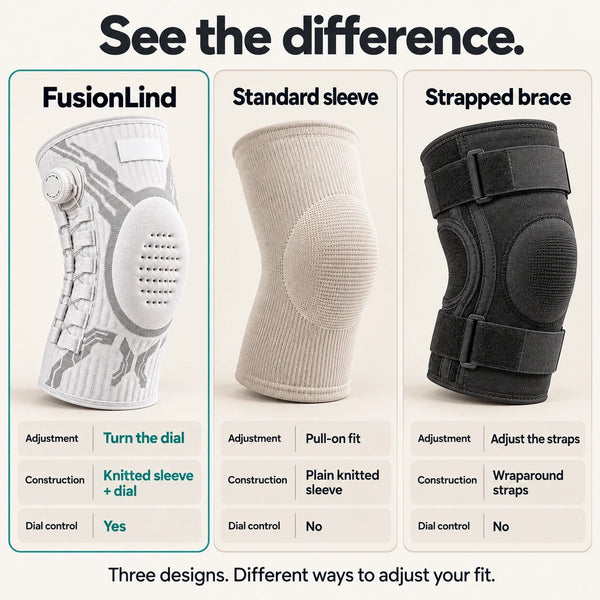
Fit comes next. A support that's too loose does nothing, and one that's too tight gets pulled off by lunchtime. Fixed-size sleeves force you to pick one tension for everything. A dial-adjustable design lets you set a lighter hold for the office and a firmer one for the walk home, one-handed and without taking it off. The complete guide to knee supports explains the different types, and the Australian buyer's guide to knee supports covers what's worth paying for.
The FusionLind Dial Knee Support was built around exactly this pattern of use: a precision dial, a kneecap gel pad, dual flexible side stabilisers and a non-slip silicone grip, in sizes M to XXL for the left knee, the right, or both. It's a comfort and support product rather than a medical device, so treat it as one tool among several. For a full walk-through of the four features and how to size it, read our complete FusionLind Dial Knee Support guide.
Where to from here
Everyday knee pain rarely needs dramatic treatment. It needs good shoes, stronger hips and thighs, sensible pacing on hills and long shifts, and a support that stays put and adjusts to the day you're having. See a GP or physio if the pain is new, severe, swollen or not settling after a few weeks.
If you want a support designed for exactly this kind of life, take a look at the FusionLind Dial Knee Support. Free shipping across Australia and a 60-day money-back guarantee mean you can try it on your own tracks, stairs and shifts.
Frequently asked questions
Can I wear a knee support for walking every day?
Yes, for most people a soft compression support is fine to wear daily during activity. Take it off when you're resting, keep the skin clean and dry, and loosen the dial if your lower leg tingles or swells. Pair daily wear with strength work so the muscles keep doing their share.
Should I wear a knee support uphill or downhill when hiking?
Downhill is where most walkers notice the benefit, because the kneecap is loaded hardest while the quads brake your descent. Many people wear a light setting all day and turn the dial firmer at the top of a steep section, then back it off again once the track flattens out.
Will a knee support help if I stand all day at work?
It may help ease the ache of long standing by keeping the joint warm and giving it a steadier feel. It works best alongside supportive shoes, an anti-fatigue mat if you're on concrete, and regular small movements. A non-slip grip matters so it stays up under work trousers.
Is it safe to wear a knee support on a long flight?
Generally yes, set to a light hold, as long as you get up and move regularly and loosen it if your leg feels tight or swollen. It isn't a substitute for compression socks or medical advice about clots. If you have circulation problems, check with your GP first.
Do I need a knee support for both knees or just one?
Start with the knee that hurts. The other knee often starts to complain once you walk more, which is why FusionLind offers Left, Right or Both options. If both knees ache, the Both option gives you one left and one right support in the same size.
This article is general information and isn't a substitute for professional medical advice. If pain persists, worsens, or you're unsure, speak with your doctor or physio.