If your knee has started to complain on stairs, after a long walk, or halfway through a game of netball, you've probably wondered whether a knee support, often sold as a soft knee brace, would help. Chemist shelves and online stores are full of sleeves, straps, braces and dials, and the labels rarely explain what each one does.
This knee support guide is the starting point. It covers what a knee support is and isn't, the main types, how compression and stabilisation work on a sore knee, who tends to benefit, and how to choose, measure and wear one without the usual mistakes, with links to deeper articles on each point.
One honest note first: a knee support is a comfort and stability tool, not a fix for the cause of the pain. Use it alongside good advice, not instead of it.
What a knee support is (and what it isn't)
A knee support is a wearable sleeve or wrap that sits around the knee joint and does two things: it applies gentle, even compression to the soft tissue, and it gives the joint a sense of being held. Most are made from a stretch fabric or neoprene, sometimes with gel pads, flexible side stays or an adjustable closure.
What a support is not is a rigid brace. A hinged brace has metal or hard plastic struts on either side that physically block certain movements, and it's usually prescribed after a significant ligament injury or surgery. A support is softer, lighter and far less restrictive. If you're unsure which category you need, the piece on the difference between a knee support and a knee brace walks through it in plain terms.
Be clear, too, about what a support can and can't do. It can take the edge off aching, add a feeling of stability, and give you the confidence to keep moving. It can't change the structure of the joint or replace rehab. If your pain came from a sudden twist, a fall or a pop you felt, start with the knee injury recovery and rehab guide and get it assessed. For pain that crept in gradually, the guide to knee pain causes and what actually helps is the better place to begin.
The main types of knee support
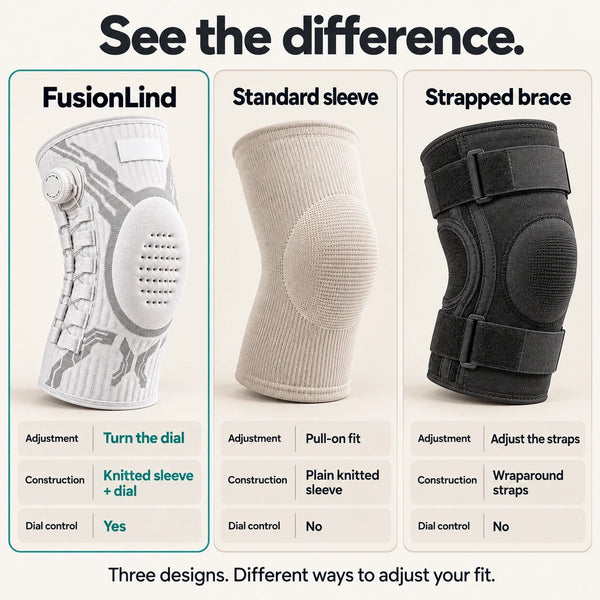
Knee supports fall into four families, and most products are a variation on one of them. Compression sleeves are the simplest: a tube of stretch fabric you pull on. They're light, cheap and fine for mild aches, but they come in fixed sizes and tend to slip. Patella straps are a thin band worn just below the kneecap to change how the tendon loads; runners and jumpers like them, but they do nothing for the rest of the joint.
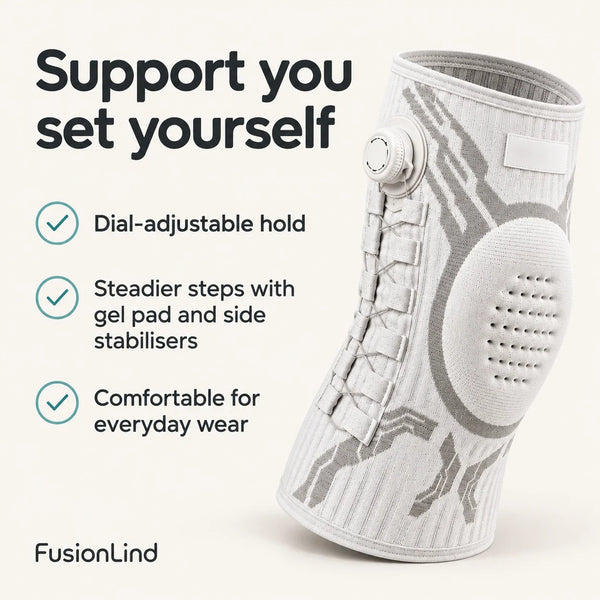
Hinged braces sit at the heavy end, built for post-injury protection rather than everyday comfort. Dial or adjustable supports are a newer category: a sleeve with stabilisers and a closure you can tighten or loosen while you wear it, so the fit changes with your day instead of being locked in when you put it on.
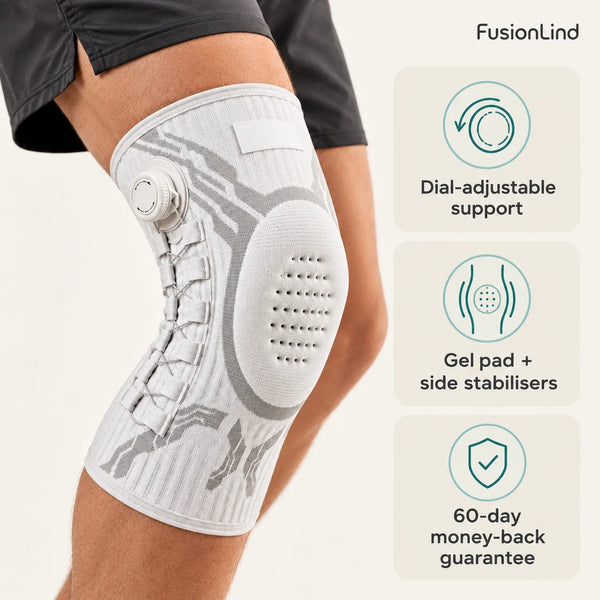
Each has a sensible use. The full breakdown of sleeves, straps, hinged and dial supports goes into who each one suits. If you want a worked example of the adjustable style, the FusionLind Dial Knee Support guide explains how one brand has combined a precision dial, a kneecap gel pad, dual side stabilisers and a silicone grip in a single everyday support.
Price and quality vary a lot within every type, and a higher price doesn't automatically mean a better fit. The Australian knee support buyer's guide covers how to judge value rather than just cost.

How compression and stabilisation actually help
Two mechanisms do most of the work, and knowing them sets realistic expectations.
Compression is the gentle squeeze of the fabric. It gives the skin and the tissue underneath constant feedback, which the nervous system reads as reassurance. Many people describe the knee as feeling switched on. That sense of position, called proprioception, tends to dull when a joint is sore or swollen, and a support gives some of it back. Compression also helps keep mild swelling from pooling around the joint during a long day on your feet. The article on how a compression knee support works goes deeper without the jargon.
Stabilisation is the second piece. Flexible stays along each side of the knee resist small sideways wobbles without stopping you bending and straightening. They won't hold a torn ligament together. What they do is reduce the micro-movements that make an irritable knee flare, so the joint feels steadier when you step off a kerb or change direction.
For people with osteoarthritis, these two effects explain why a support often feels good even though the underlying wear hasn't changed. Exercise remains first-line care for knee osteoarthritis in every major guideline, and a support is a tool that may help you do more of it comfortably. The practical guide to knee arthritis and ageing knees covers that bigger picture.
Who tends to benefit from a knee support
A knee support earns its place in a few recognisable situations. The first is active people with a grumbling knee. Walkers, bushwalkers, gym-goers, netballers and weekend footy players who get a dull ache during or after activity often find a support lets them keep training while they work on strength. The guide to knee support for sport and exercise covers which activities suit a support and which call for a rest and a physio visit.
The second is people on their feet all day. Nurses, tradies, retail staff and anyone standing on concrete for a shift tend to notice knee fatigue by mid-afternoon. A support worn during work hours can take the edge off. The walking, hiking and everyday knee support guide is the hub for that kind of use, from the morning dog walk to a long-haul flight.
The third is older knees. If stairs, getting out of a chair or the first steps in the morning have become a negotiation, a support may add a steadiness that gives you confidence to keep moving.
Who should be cautious? Anyone with a recent acute injury, unexplained swelling, numbness, or circulation problems should see a GP first. If one knee hurts and the other is fine, read whether you need a left, right or both knee supports before buying two. The FusionLind Dial Knee Support is sold per knee for exactly that reason.
How to choose, fit and wear a knee support
Getting the fit right matters more than the brand. Start by measuring. Most supports size from the circumference of the thigh a hand-width above the kneecap, sometimes with the calf as a second check. Measure standing, with a soft tape, and don't guess from your trouser size. The step-by-step on measuring your knee for the right support size shows exactly where to put the tape.
Next, tension. A support should feel snug, never pinching, and you should be able to slide a finger under the edge. If your toes tingle or the skin below goes blotchy, it's too tight. The guide on how tight a knee support should be covers the sweet spot, and it's where an adjustable dial beats a fixed sleeve: back it off on the couch, firm it up for a walk.
Then decide when to wear it. Most people do best wearing a support for the activities that bother the knee and taking it off at rest. The article on how long to wear a knee support each day explains why that matters for the muscles around the joint. The common mistakes are predictable: buying a size up to be safe, wearing it over thick trackies, never washing it, and expecting it to fix a problem that needs a physio.
Conclusion
A knee support is a simple tool that does two honest jobs: it compresses, and it steadies. Choose the type that matches your situation, measure before you buy, wear it snug but not tight, and keep it for the activities that bother your knee. Pair it with strengthening work and proper advice when pain lingers, and it can be a genuine help in staying active.
If an adjustable, everyday support sounds like the right fit, the FusionLind Dial Knee Support comes in sizes M to XXL, for left, right or both knees, with free shipping across Australia and a 60-day money-back guarantee.
Frequently asked questions
What does a knee support actually do?
A knee support applies gentle compression to the tissue around the joint and adds a feeling of stability through flexible side stays or a snug fit. That combination may help ease aching, improve your sense of where the knee is, and give you confidence to keep moving. It doesn't change the joint itself.
Is a knee support the same as a knee brace?
No. A knee support is a soft, flexible sleeve or wrap built for comfort and everyday stability, and many Australians simply call it a soft knee brace. A rigid knee brace has hinges or struts that limit movement and is typically prescribed after a ligament injury or surgery. Most people with general knee aches need the soft kind.
How do I know what size knee support to buy?
Measure the circumference of your thigh about a hand-width above the kneecap while standing, using a soft tape. Compare that number to the brand's size chart rather than guessing from clothing size. If you fall between sizes, an adjustable support gives you more room to fine-tune the fit.
Can I wear a knee support all day?
You can, but most people do better wearing it during the activities that bother the knee and removing it at rest. That keeps the muscles around the joint doing their share of the work. Take it off at night unless a physio has told you otherwise, and check your skin for marks.
Will a knee support help arthritis in my knee?
It may help ease the aching and stiffness of an arthritic knee and make walking or exercise feel steadier, which matters because movement is the foundation of arthritis care. It won't change the wear inside the joint. Think of it as a tool that supports activity, alongside advice from your GP or physio.
This article is general information and isn't a substitute for professional medical advice. If pain persists, worsens, or you're unsure, speak with your doctor or physio.