You've typed "knee support vs knee brace" into a search bar because your knee has been complaining and the chemist shelf, the physio and your mate from netball all seem to use the words differently. Some are soft sleeves, some have metal hinges, and prices range from a takeaway lunch to a car repair bill.
The words matter because they describe very different levels of support, and picking the wrong level is the most common way people waste money on knee gear. This article sorts out the terminology, walks through the ladder from light compression to rigid bracing, and explains which everyday situations suit which option.
If you want the full picture on how these products work, our complete guide to knee supports covers types, fit and mechanism in more depth. Here we stay on the one question in the title.
What "knee support" and "knee brace" actually mean
In everyday Australian use, a knee support is a soft, flexible product that wraps around the joint. Think compression sleeves, adjustable wraps and strap-based designs. They are made from knit fabric, neoprene or similar materials, and any stabilising parts are flexible rather than rigid. You can pull one on in the car park before a walk and forget it is there.
A knee brace, in the stricter sense, is a structured device with rigid or semi-rigid components. Hinged braces have metal or hard plastic uprights running down each side of the knee, connected by a hinge that controls how far the joint can bend or straighten. Some braces also have adjustable range-of-motion stops, which a physio or surgeon sets after an injury or operation.
The confusion comes from marketing. Plenty of products sold as "braces" online are really supports, and some pharmacies label a basic sleeve a brace because it sounds more serious. A useful test: if you can roll it up and stuff it in a gym bag without worrying about bending anything, it is a support. If it has hard parts that hold a shape on their own, it is a brace.
Neither word is better than the other. They are tools for different jobs, and the rest of this article is about matching the tool to your knee.
The support ladder: from light compression to rigid hinges
It helps to picture knee products on a ladder. Each rung adds control and takes away freedom, and the right rung depends on how much your knee needs to be held.
- Compression sleeve. A snug tube of fabric. It warms the joint, gives gentle all-round pressure and improves your sense of where the knee is in space. Lowest control, highest freedom.
- Adjustable support with flexible stabilisers. A sleeve or wrap with a tightening mechanism and bendy side inserts. You can set the hold to suit the day, and the stabilisers add side-to-side steadiness without blocking normal bending.
- Patella strap. A narrow band below the kneecap that targets the patellar tendon. Very specific, not much general support.
- Hinged soft brace. A neoprene body with hinged metal uprights. More side-to-side control, bulkier, hotter in summer.
- Rigid functional or post-operative brace. Hard shells, locking hinges, often fitted by a professional. Maximum control, minimal freedom.
Most everyday knees live on the first two rungs. The different types of knee supports on those rungs vary a lot in comfort and adjustability, which is where the real buying decision happens for most people.
Climbing higher on the ladder is not a free upgrade. Extra hardware adds weight, rubs behind the knee, and gets in the way of walking normally. The goal is the lowest rung that gives your knee what it needs.

When a knee brace is the right call
Rigid and hinged braces earn their place after significant structural injury. If you have torn a ligament such as the ACL or MCL, had a meniscus repair, or are coming out of knee surgery, your surgeon or physio may prescribe a brace that limits certain movements while tissue settles. In those cases the brace is part of a plan, with a set wearing schedule and a date to wean off it.
Braces also suit knees that genuinely give way. If your knee buckles sideways on uneven ground, or you feel it shift when you change direction on a footy field, that mechanical instability needs more than fabric. A hinged brace resists the sideways and rotational forces a soft support cannot. Again, that is a decision to make with a physio, not a product page.
The common thread is that someone qualified has looked at the knee first. A brace bought off the shelf without that assessment is a guess, and an expensive one. It can also do harm by letting you push into activities the knee is not ready for, or by weakening the muscles that should be doing the work if worn for months on end.
If you are in the injury camp, start with our knee injury recovery and rehab guide, then book the appointment. Let the professional choose the brace, the settings and the timeline.
When a knee support is the better everyday choice
Now the side of the ledger where most readers actually sit. Your knee is sore rather than unstable. It aches after a long walk, grumbles on stairs, feels stiff on cold mornings or gets tired during a shift on your feet. There was no dramatic injury, just wear, age or a lot of use. That is support territory.
A good support does three useful things for this kind of knee. It adds gentle compression, which many people find takes the edge off that achy, heavy feeling. It gives the joint a sense of being held, which builds confidence to keep moving. And flexible stabilisers add a touch of side-to-side steadiness without turning your knee into a hinge.
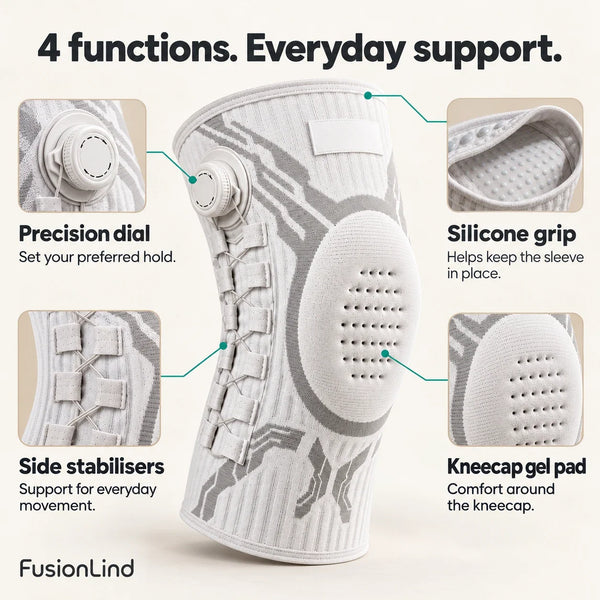
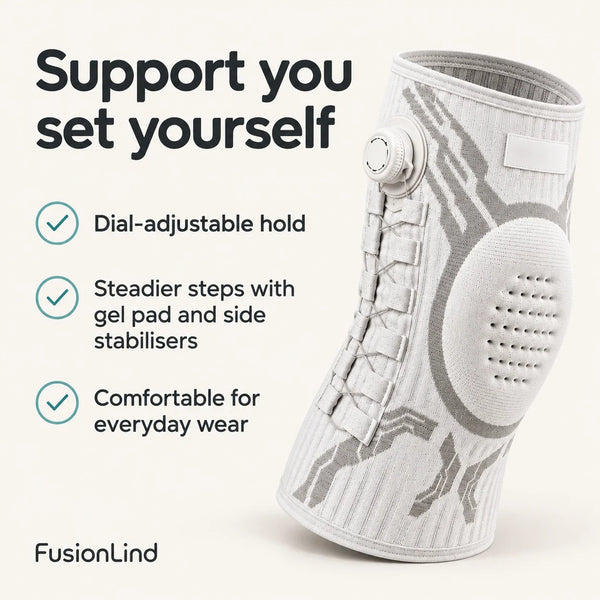
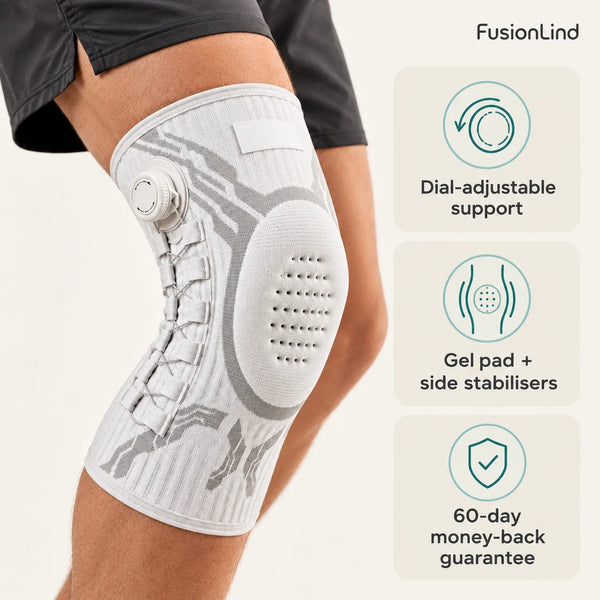
This is the thinking behind the FusionLind Dial Knee Support. The precision dial lets you set a lighter or firmer hold, one-handed, and change it mid-walk when the track gets steeper. The dual side stabilisers are flexible, so you still bend and squat normally. It is designed for comfort and stability through everyday movement, sport and work, not as a medical device.
Supports also suit the long game of living well with arthritic or ageing knees, where staying active is the priority and a rigid brace would just get in the way. The same applies to sport and exercise with sore knees when the joint is structurally sound.
How to decide, and what to ask your physio
Start with the honest question: is my knee sore, or is it unstable? Soreness, stiffness, swelling after activity and aching at night point towards a support plus a sensible plan of strengthening and load management. Giving way, locking, a loud pop at the moment of injury, or an inability to bear weight point towards a professional assessment and possibly a brace.
Next, think about your week. A tradie kneeling on concrete, a nurse on a twelve-hour shift and a retiree doing coastal walks all need something they can wear for hours without chafing or rolling down. Bulky hinged hardware fails that test quickly. A support with a non-slip grip and adjustable tension passes it. Our guide to knee support for walking and everyday life goes deeper on those scenarios.
If you do see a physio, bring specific questions. Ask whether your knee needs movement restriction or just comfort and confidence. Ask how many hours a day you should wear anything, and for how many weeks. Ask what exercises should run alongside it, because no product replaces strong quads and glutes.
Finally, weigh the money. A brace fitted for a torn ligament is worth every dollar. The same brace bought for a knee that simply aches on stairs is an expensive, sweaty mistake. Our Australian knee support buyer's guide lays out what to pay for and what to skip.
The bottom line
A knee support and a knee brace are not rival products, they are different rungs on the same ladder. Braces control movement after serious injury or for knees that give way, and belong in a plan set by a physio or surgeon. Supports add compression, steadiness and confidence for the far larger group of knees that are sore, stiff or tired but structurally sound.
If your knee sits in that second group and you want a hold you can adjust through the day, take a look at the FusionLind Dial Knee Support. It ships free across Australia and comes with a 60-day money-back guarantee, so you can test it on your own stairs and tracks.
Frequently asked questions
Is a knee support the same as a knee brace?
No. A knee support is soft and flexible, built from fabric or neoprene with bendy stabilisers at most. A knee brace has rigid or hinged parts that physically limit movement. Shops and many Australians call soft supports knee braces too, so judge by construction: hard uprights or a hinge make it a brace.
Do I need a knee brace or a knee support for arthritis?
For most arthritic knees, a soft support is the sensible starting point. It adds warmth, gentle compression and a sense of stability while you keep walking and strengthening. Hinged unloader braces exist for specific arthritis patterns, but a specialist fits and prescribes those, they are not shelf purchases.
Can a knee support replace a brace after an ACL injury?
No. After a ligament tear or reconstruction, your surgeon or physio decides what, if anything, your knee should wear and for how long. A soft support cannot block the sideways and rotational forces a damaged ligament needs protecting from. Follow the professional plan, and ask before swapping anything.
Will wearing a knee support make my knee weaker?
Worn sensibly, no. A soft support does not take over your muscles' work, it adds compression and a feeling of steadiness so you move more. Problems come from wearing rigid braces for months without rehab, or using any product as an excuse to skip strengthening. Keep the exercises going.
Which is better for sport, a knee support or a knee brace?
It depends on the knee, not the sport. A structurally sound knee that aches during netball, running or gym work usually does better with a flexible support that moves with you. A knee with a known ligament injury may need a hinged brace cleared by a physio. Get assessed if unsure.
This article is general information and isn't a substitute for professional medical advice. If pain persists, worsens, or you're unsure, speak with your doctor or physio.