You're standing in the chemist aisle, or scrolling through pages of knee supports online, and they all claim to be the answer. Some are thin sleeves, some are bulky braces with metal hinges, and prices run from pocket change to a few hundred dollars. Picking the best knee support in Australia, or soft knee brace as many shops call it, is harder than it should be.
This buyer's guide gives you a straightforward decision framework. You'll work through what you need the support for, which format suits that need, how to get size and adjustability right, what to look for in materials and grip, and what a fair price and guarantee look like. We'll also be honest about where the FusionLind Dial Knee Support fits in and where it doesn't.
If you're new to knee supports altogether, our complete guide to knee supports explains the basics before you compare options.
Start with the job it needs to do
The best knee support is the one that matches the job. Before you look at a single product, be clear about why your knee needs help. A support that suits a netball player will frustrate someone with arthritic knees who just wants to get through the shops comfortably.
People buy a knee support for one of five reasons. Everyday aches and stiffness, often from arthritis and ageing knees, call for comfortable compression you can wear for hours. Sport and training, whether that's footy, running or the gym, need something that stays put through sweat and sudden changes of direction, which we cover in knee support for sport and exercise. Long days on your feet, coastal walks and bush tracks sit in the middle, and knee support for walking, hiking and everyday life looks at those in detail.
The fourth group is recovering from an injury. The right product here depends on what your physio or surgeon has said, and our knee injury recovery and rehab guide explains why a soft support and a rigid brace aren't interchangeable. The fifth group has pain they can't explain yet. If that's you, read about knee pain causes, symptoms and what helps, and see a GP or physio before spending money. A support may help ease the ache, but it won't tell you what's causing it.
Knee sleeves, straps, hinged braces and dial knee braces compared
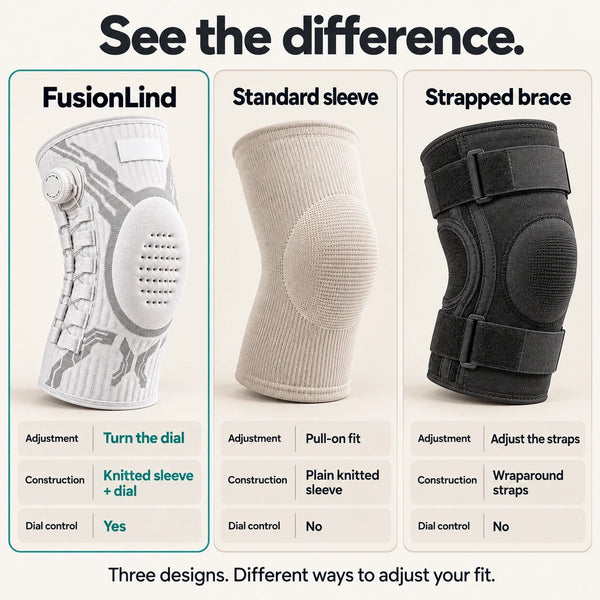
Knee supports come in four main formats, and each has a genuine use. A compression sleeve is a tube of neoprene or knit fabric that gives gentle, even pressure and warmth. It's light, cheap and easy to wear, but you can't adjust it once it's on, so a slightly wrong size is either too loose or tight enough to pinch.
Velcro straps and wraps fix the adjustability problem, but they bring their own. The hook-and-loop wears out, the straps bunch behind the knee, and resetting the tension mid-walk means stopping and fiddling with both hands. We weigh this up in dial knee support versus Velcro straps.
Hinged braces have rigid or semi-rigid bars down each side. They're the right call after certain ligament injuries or when a specialist wants to limit side-to-side movement, but they're heavy, hot in an Australian summer and more support than most sore knees need for a walk or a shift at work. Knee sleeve versus hinged brace goes deeper on that choice.
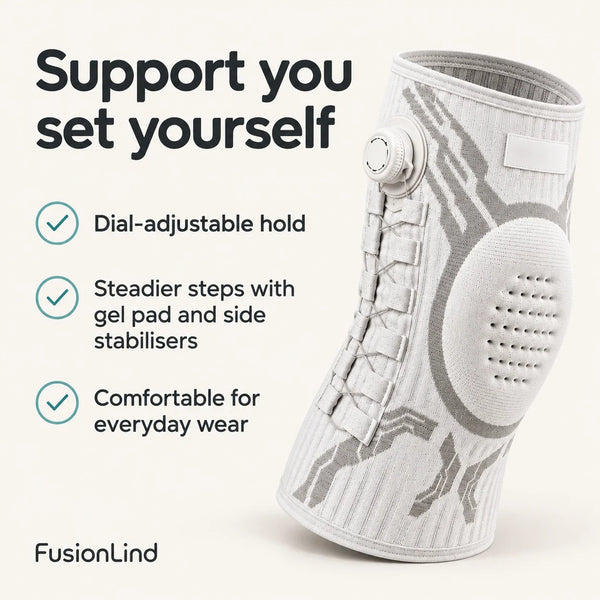
Dial supports are the newest format. A small dial tightens or loosens the hold in seconds, with one hand, while the support is on your leg. You get the comfort of a sleeve with adjustability a strap can't match. Kinesiology tape is sometimes pitched instead, and knee support versus kinesiology tape explains when tape makes sense and when it doesn't.

Getting size and adjustability right
Fit decides whether a knee support works or ends up in a drawer. Most brands size by the circumference of your leg, measured either around the centre of the kneecap or a set distance above it, so dig out a soft tape measure and follow the brand's own chart rather than guessing from your jeans size.
If you're between sizes, think about how you'll use it. A support for long walks or a work shift should sit a touch firmer so it doesn't migrate down your leg, while one for arthritic knees that swell through the day needs room to loosen. This is where adjustability earns its keep. A fixed sleeve can't respond to a knee that's puffier at 4pm than it was at 7am, but a dial can be eased off in a second without taking anything off.
Larger thighs and calves have been poorly served by one-size-fits-most supports, which tend to dig in at the top and roll at the bottom. The FusionLind Dial Knee Support comes in M, L, XL and XXL, and our sizing and fit guide for larger legs explains how to measure and what to expect. For a broader look at which specifications actually change how a support feels, the knee support features that matter separates the useful from the gimmicks, including why a kneecap gel pad beats thicker neoprene.
Materials, grip and how long it should last
Two things determine whether you'll still be wearing a support in three months: the fabric against your skin and whether it stays where you put it. Neoprene holds warmth well, which many people with stiff or arthritic knees love in a Melbourne or Canberra winter, but it gets sweaty under work trousers in January. Knit fabrics breathe better and feel more like a sock, at the cost of a little warmth. Neoprene versus knit fabric walks through the trade-offs so you can match the material to your climate and routine.
Grip is the feature nobody thinks about until they're hitching a support back up every hundred metres. Look for a band of silicone on the inside of the top edge. Without it, every step pulls the fabric down a fraction, and by lunchtime the support is around your shin doing nothing. The FusionLind non-slip silicone grip exists for exactly this reason, and it matters more the longer you wear the support.
Finally, think about lifespan. Stitching, elastic and Velcro all fatigue, and a support that has lost its tension is giving you reassurance rather than stability. Our article on how long a knee support lasts lists the signs to replace one. A cheaper support that needs replacing every few months rarely works out cheaper, so weigh construction quality alongside the ticket price.
Price, guarantee and where FusionLind fits
Knee supports in Australia range from a cheap chemist sleeve to specialist braces costing several hundred dollars. The cheap end often means fixed sizing, no grip and a short lifespan, while the expensive end is usually built for post-surgical needs most people don't have. How much a good knee support should cost breaks down what you're paying for at each tier.
A guarantee matters more with knee supports than with most purchases, because you can't know how a support feels on a long walk or a full shift until you've done one. Look for a return window long enough to actually test it.
Here's where we sit. The FusionLind Dial Knee Support is AUD $69 for one, $119 for two and $159 for three, with free shipping across Australia and a 60-day money-back guarantee. It combines a precision dial you can adjust one-handed, a kneecap gel pad that helps spread pressure, flexible dual side stabilisers for everyday movement and a non-slip silicone grip. It is a comfort and support product for everyday life, sport and work, not a medical device, and it's not the right choice if a surgeon has told you to wear a rigid brace. Everything you need to know about FusionLind covers the detail.
The bottom line
Choosing the best knee support in Australia comes down to a short checklist. Know the job, then pick the format that matches it, which for most everyday, work and sporting knees means a well-fitted sleeve or dial rather than a hinged brace. Measure properly, favour adjustability if your knee changes through the day, insist on grip, and judge price against how long the support will actually last.
If that checklist points you towards an adjustable, all-day support, take a look at the FusionLind Dial Knee Support. With free shipping across Australia and a 60-day money-back guarantee, you can test it on your own walks and shifts and decide for yourself.
Frequently asked questions
What is the best knee support for everyday use in Australia?
For everyday wear, most people do best with a comfortable compression support rather than a rigid brace. Look for accurate sizing, a non-slip grip, breathable fabric for warm weather and some way to adjust the hold through the day. A dial-adjustable support ticks those boxes for walking, work and light sport.
Should I buy a knee sleeve or a hinged knee brace?
A hinged brace suits situations where a physio or surgeon wants to limit sideways movement, usually after a ligament injury or surgery. For general aches, arthritis, work and most sport, a sleeve or dial support gives enough stability with far less bulk and heat. If a clinician has prescribed a brace, follow their advice.
How do I know what size knee support to buy?
Use a soft tape measure and follow the brand's own sizing chart, as makers differ. Most charts use the circumference around the centre of the kneecap or a set distance above it. Measure both legs, as they often differ, and if you sit between sizes decide whether you want a firmer or roomier hold.
Can I wear a knee support all day?
Many people wear a comfortable compression support through a full working day or long walk without trouble. Loosen it if you notice tingling, numbness or skin marks that don't fade quickly, and take it off at night unless a clinician has said otherwise. An adjustable dial makes easing the hold simple.
Is a more expensive knee support always better?
No. Price usually tracks how specialised a support is, not how well it suits you. Expensive hinged braces suit post-surgical needs most people never have, while very cheap sleeves often skimp on sizing, grip and durability. The sweet spot for everyday use is a mid-priced support with proper sizing, adjustability and a solid guarantee.
This article is general information and isn't a substitute for professional medical advice. If pain persists, worsens, or you're unsure, speak with your doctor or physio.