Your knee has started talking to you. Maybe it grumbles on the stairs at work, stiffens after a long drive, or aches at night after a weekend of bushwalking. Knee pain causes range from simple overload to arthritis and injury, and the pattern of your pain often says more than any single symptom.
This guide is the hub for everything we have written about knee pain. It walks through how the joint is built, the most common causes by location and by situation, the warning signs that mean you should stop guessing and see a GP or physio, and the self-care that genuinely helps. We also cover where a knee support (or soft knee brace, as many shops call it) fits in, honestly, without pretending it fixes everything.
Each section links to a deeper article on that specific problem, so you can go as far as your knee needs.
How the knee works and why it complains
The knee is the largest joint in the body. The thigh bone (femur) sits on top of the shin bone (tibia), with the kneecap (patella) gliding in a groove at the front. Smooth cartilage coats the bone ends, two crescent-shaped menisci act as shock absorbers, and four main ligaments hold it together: the ACL and PCL inside the joint, the MCL on the inner side and the LCL on the outer side.
Around that core sit the quadriceps and hamstring tendons, small fluid-filled bursae that reduce friction, and a capsule that produces lubricating fluid. When any of these structures is irritated, overloaded or torn, you feel it as knee pain. Cartilage has no nerve supply, which is why wear can be well advanced before it hurts, a point we unpack in our practical guide to knee arthritis and ageing knees.
The knee also sits between two joints it cannot control. A stiff hip or a collapsing foot arch changes how load travels through the knee, so it often pays for a problem that started above or below. Good physios look at the whole leg, which is why our knee injury recovery and rehab guide covers hips and ankles too.
Knees are also noisy. Clicks and pops are usually harmless gas bubbles or tendons flicking over bone, and we sort the normal noises from the worrying ones in our article on knee clicking and popping.
Common knee pain causes by location
Where it hurts is your first clue. Pain at the front, around or under the kneecap, is most often patellofemoral pain: the kneecap tracking slightly off-centre in its groove and irritating the tissue beneath. It flares on stairs, squats and hills, and it is the usual culprit when knee pain going up and down stairs is your main complaint. Pain just below the kneecap after jumping or running points more towards the patellar tendon.
Inner knee pain has a longer list of suspects: the medial meniscus, the MCL, a small bursa called the pes anserine, or early osteoarthritis, which tends to wear the inner compartment first. Our article on inner knee pain causes helps you tell them apart. Outer knee pain in runners and cyclists is frequently the iliotibial band rubbing near the joint, covered in our guide to outer knee pain and the IT band, though the lateral meniscus and LCL can also be involved.
Pain at the back of the knee is the one people worry about most. Tight or strained hamstring tendons, a Baker's cyst (a fluid pocket that forms when the joint is irritated) and calf strains are the common causes. Deep, constant pain with calf swelling and warmth is the exception that needs same-day medical attention. We cover the full picture in pain behind the knee and when to worry.

Knee pain by situation: walking, stairs, sitting and night
The second clue is when it hurts. Pain that builds the longer you walk usually points to overload of a joint that is not quite strong enough for the distance. Shoes, pace and surface all matter, and we break down the fixes in our article on knee pain when walking and in the wider guide to knee support for walking, hiking and everyday life.
Stiffness and a dull ache after sitting through a movie, a long meeting or a flight is so common it has a nickname. The kneecap is pressed against the thigh bone the whole time you sit with bent knees, and the first few steps afterwards feel rusty. It responds well to regular movement breaks, as explained in knee pain after sitting.
Night pain is different again. A knee that aches once you lie down is often an inflamed or arthritic joint with no daytime distraction, or a sign that the day's load was too much. Pillow position, evening routines and gentle movement all help, and our article on knee pain at night goes through each one.
Sport brings its own patterns: pain during cutting and landing in netball or footy, after long runs, or under a heavy bar at the gym. Each has its own cause and fix, covered in our Australian guide to knee support for sport and exercise.
Red flags: when knee pain needs a doctor
Most knee pain is mechanical and settles with sensible management. Some of it is not, and the sooner it is assessed the better the outcome. See a GP or go to an emergency department promptly if you notice any of the following.
- You cannot put weight through the leg, or the knee gives way or locks so you cannot straighten it.
- Marked swelling within hours of a twist, fall or tackle, which can signal a ligament or meniscus tear.
- An obviously deformed knee or kneecap after an injury.
- A hot, red, swollen knee with fever, which needs same-day assessment to rule out infection.
- Numbness, pins and needles, or a foot that has gone pale or cold.
Short of those emergencies, there is a second tier: pain that has not improved after a few weeks of sensible care, pain that wakes you repeatedly, or swelling that keeps coming back without an obvious reason. Those deserve a proper assessment too. We lay out exactly who to see and what to expect in when to see a doctor about knee pain.
Swelling on its own is worth understanding, because the knee produces extra fluid for different reasons, from a bruised joint lining to gout. Our article on swollen knee causes and relief explains how to read it and what to do while you wait for an appointment.
What actually helps, and where a knee support fits
Exercise is first-line care for knee osteoarthritis in every major guideline, and the same principle holds for most other knee pain causes: a stronger, better-controlled leg takes load off the irritated structure. Strengthening the quadriceps, glutes and calves, improving hip and ankle mobility, and building walking tolerance gradually are the core of nearly every physio plan. Short-term tools such as ice, heat, relative rest and supportive footwear take the edge off while that work happens.
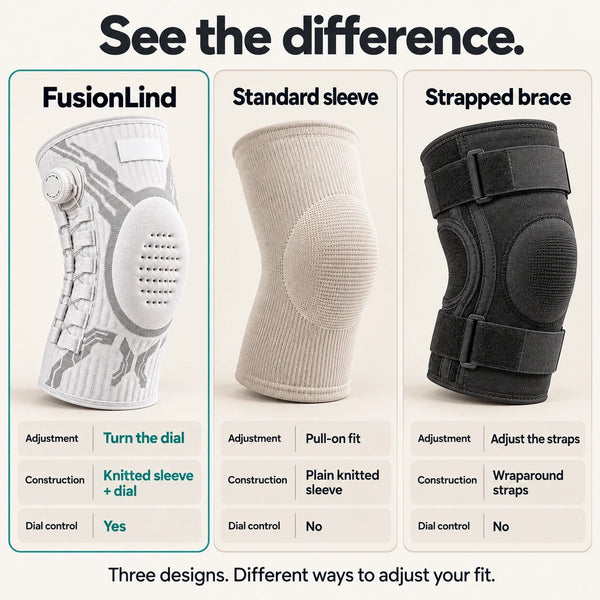
A knee support, the kind some people call a knee brace, belongs in that short-term toolkit. It does not change the structure of the joint, and it is not a substitute for strengthening or for a diagnosis. What it can do is add stability through everyday movement, give you confidence to keep walking or working, and make the joint feel more held together on days when it is cranky. Our complete guide to knee supports explains the mechanisms in detail.
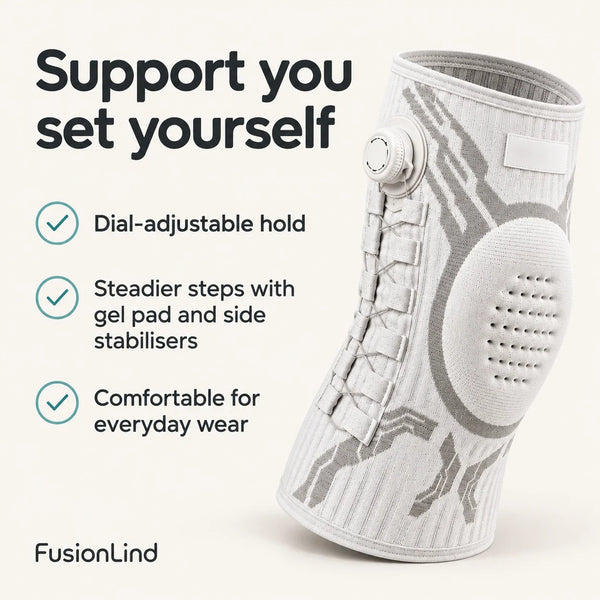
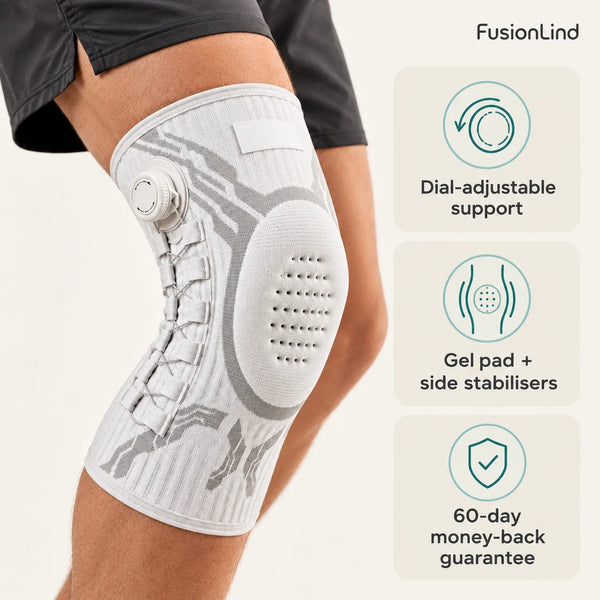
The FusionLind Dial Knee Support is built around that job. A precision dial lets you set a lighter or firmer hold and adjust it one-handed through the day, a kneecap gel pad helps spread pressure around the kneecap more comfortably, and flexible dual side stabilisers support the knee without rigid hinges. If you are comparing options, our buyer's guide to knee supports in Australia covers what matters, and the full FusionLind Dial Knee Support guide answers the product-specific questions.
The bottom line
Knee pain causes are rarely mysterious once you pay attention to where it hurts, when it hurts and what set it off. Front, inner, outer and back of the knee each have their usual suspects. Rule out the red flags, see a GP or physio if things are not improving, and then commit to the strength work that changes the trajectory.
If a bit of extra stability would help you stay active while you do that, take a look at the FusionLind Dial Knee Support. It comes with free shipping across Australia and a 60-day money-back guarantee, so you can test it on your own stairs.
Frequently asked questions
What is the most common cause of knee pain?
In adults the most common causes are patellofemoral pain at the front of the knee, osteoarthritis in people over 50, and overload of tendons or the meniscus from sport or sudden increases in activity. Where the pain sits and what triggers it narrows the list considerably.
How do I know if my knee pain is serious?
Treat it as serious if you cannot bear weight, the knee locks or gives way, it swells quickly after an injury, it looks deformed, or it is hot and red with a fever. Pain that has not improved after a few weeks of sensible care also deserves a GP or physio visit.
Should I rest or keep moving with a sore knee?
For most knee pain, keep moving within comfort. Complete rest weakens the muscles that protect the joint. Reduce the activities that clearly aggravate it, keep walking on flat ground, and add gentle strengthening. If movement is impossible or pain is sharp and worsening, get it assessed first.
Does a knee support help with knee pain?
A knee support may help ease discomfort by adding stability and a sense of security through everyday movement, which can give you confidence to stay active. It does not fix the underlying cause, so pair it with strengthening and, where needed, a proper diagnosis from a GP or physio.
Why does my knee hurt more at night and in the cold?
At night there is less to distract you from a joint that has been loaded all day, and lying still lets stiffness build. Cold weather tends to make joints feel tighter and muscles less compliant. Keeping the knee warm, moving gently before bed and reviewing the day's load usually helps.
This article is general information and isn't a substitute for professional medical advice. If pain persists, worsens, or you're unsure, speak with your doctor or physio.