You set off for your usual walk and within a few hundred metres your knee starts to complain. Or it feels fine on the footpath but grumbles the moment you hit sand or a cambered road. Knee pain when walking is one of the most common reasons Australians cut back on the one form of exercise their knees actually need.
The good news is that the pattern of your pain tells you a lot. Pain at the start of a walk that eases points to something different from pain that builds after a few kilometres, and pain on rough ground is different again. This article covers those patterns, footwear, pacing, and where a knee support (or soft knee brace) fits in. For the broader picture on what drives sore knees, our guide to knee pain causes, symptoms and what helps is the place to start.
Pain at the start of a walk that eases as you go
If your knee is stiff and achy for the first five or ten minutes and then loosens up, you're describing a very recognisable pattern. Physios often call it gelling. After you've been sitting or lying still, the fluid inside the joint thickens slightly, the surrounding muscles are cold, and the cartilage hasn't yet had the gentle loading that helps it cushion the joint.
Movement reverses all of that. Within a few minutes the joint fluid thins, blood flow to the quads and calves picks up, and the knee moves more freely. This pattern is common with early knee osteoarthritis and general age-related wear, which is why so many people over 50 notice it first thing in the morning or after a long drive to the start of a walk.
The practical fix is a gentler first few minutes. Start on flat ground, keep your stride short, and let the knee warm before you push the pace or tackle a hill. A minute of marching on the spot in the car park often gets the same result faster, and a warm shower before an early walk helps too. If the stiffness lasts longer than half an hour, or the joint looks swollen, see your GP rather than pushing through. Our practical guide to arthritis and ageing knees goes deeper on managing this day to day.
Pain that builds after a few kilometres
The opposite pattern is a knee that feels fine for the first stretch and then starts aching, burning or feeling full the further you go. This is usually a load problem rather than a stiffness problem. Every step asks the knee to absorb force, and when the tissues around it fatigue, the joint takes more of it directly.
The quads are the main culprit. They control how the kneecap glides and how much shock reaches the joint. As they fatigue, the kneecap can track slightly off-line and the tissues around it get irritated, which drives a lot of front-of-knee pain in walkers. Weak or tired hips and glutes make it worse because the thigh rolls inward and the knee follows.
Tendons and the fat pad under the kneecap are the other common sources. They tolerate a certain amount of loading each day, and past that threshold they let you know. The warning sign is pain that arrives at roughly the same distance each walk, then creeps earlier each week.
Pacing is your main tool here. Shorten the walk to a comfortable distance, hold it there for a couple of weeks, then add distance in small steps. A loop route you can cut short makes this easier. If pain keeps arriving earlier despite easing off, see a physio, because strengthening the quads and hips is usually what fixes this long term.

Pain on uneven ground, hills and cambered paths
Plenty of people walk comfortably on a footpath and only struggle when the surface changes. Soft sand, rocky bush tracks, wet grass and roads with a strong camber all ask the knee to do something a smooth path doesn't: stabilise side to side while it bends and straightens.
The knee is built mainly to hinge. Its side-to-side control comes from the inner and outer ligaments and the hip muscles. On uneven ground, every slightly off-centre footfall sends a small sideways nudge through the joint. Hundreds of those add up, and the inner or outer knee is where you often feel it afterwards.
Hills are a separate issue. Walking uphill loads the quads and the front of the knee as you drive up. Downhill is worse for most sore knees because the quads work hard while lengthening to brake each step, and the kneecap is pressed firmly into its groove. The same mechanics are behind knee pain going up and down stairs, so if stairs bother you, steep descents probably will too.
If this is your pattern, pick your surfaces deliberately. Walk the firm sand near the waterline rather than the soft dry stuff, choose graded tracks over rocky ones, and swap sides on a cambered road so one knee doesn't cop the slope every time. Walking poles take real load off the knees on descents and are worth carrying on bush tracks.
Footwear, pacing and the small habits that add up
Shoes matter more for knees than most people expect, but not in the way the marketing suggests. The biggest problem is usually a worn-out pair rather than the wrong brand. Once the midsole has compressed and the outsole has worn unevenly, every step lands slightly off-balance and the knee absorbs the difference. If the sole has worn through on one edge, or the shoe tips sideways when you set it on a table, retire it.
Beyond that, look for a shoe with a stable heel, enough cushioning to feel comfortable on concrete, and a sole that bends where your foot bends. Thongs and flat canvas shoes are fine for a trip to the shops but a poor choice for a serious walk. Old running shoes are a common trap, because they lose their cushioning well before they look worn, often months earlier.
Pacing is the other half. Three or four shorter walks across the week are kinder to a sore knee than one long weekend effort, because the tissues get time to recover between loads. If you've had a bad day, a flat 20-minute walk on the footpath keeps you moving without stirring things up. Watch how the knee feels the next morning as well. Soreness that settles within a day or so is a sign you've pushed a little but not too far.
When a knee support helps with walking (and when it won't)
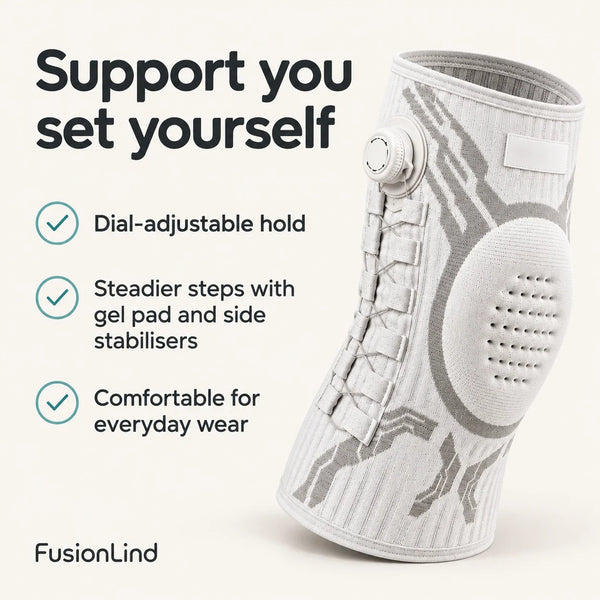
A knee support, soft knee brace or otherwise, won't change why your knee hurts, but for a lot of walkers it changes how the knee feels while they get the real fixes in place. Gentle compression gives the skin and joint steady feedback, which tends to make the knee feel more aware and steadier on uneven ground. Warmth helps with the start-of-walk stiffness described earlier. Light stabilisers on either side take the edge off those sideways nudges on rough tracks.
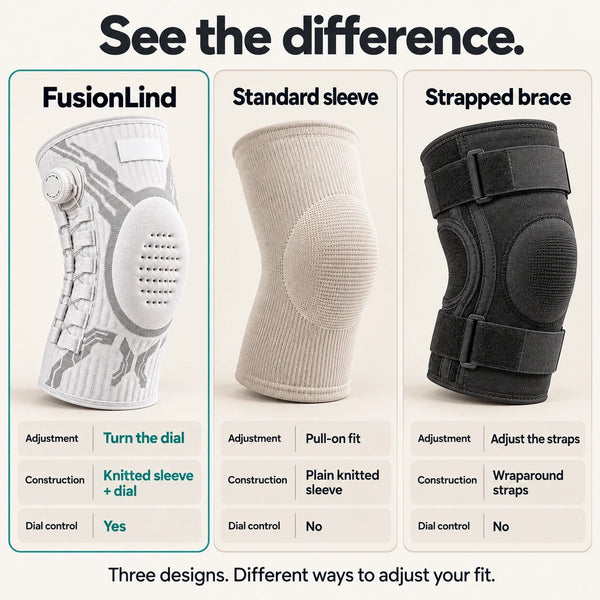
The FusionLind Dial Knee Support is designed around exactly these everyday situations. The precision dial lets you set a lighter hold for the footpath and firm it up one-handed when you turn onto a bush track. The kneecap gel pad helps spread pressure around the kneecap, which matters on descents, and the non-slip silicone grip helps stop it rolling down as you sweat. Our guide to knee support for walking and hiking covers how to use one across different walks.
Be honest about the limits, though. A support is not the right tool for a knee that gives way, locks, or swells sharply after a twist. Those need a GP or physio and sometimes a rigid brace, and the difference is explained in our piece on knee supports versus knee braces. If you're new to supports altogether, the complete guide to knee supports explains the types and how to fit them.
The bottom line
Knee pain when walking is rarely random. Stiffness that eases usually means a joint that needs a gentler warm-up. Pain that builds with distance points to tired quads and hips that need pacing and strengthening. Pain on rough ground or hills is about side-to-side control and braking load. Match the fix to the pattern: better shoes, shorter and more frequent walks, smarter routes, and a physio if it keeps progressing.
If you want steadier, more comfortable knees while you work on those basics, the FusionLind Dial Knee Support gives you adjustable, one-handed support for every kind of walk, with free shipping across Australia and a 60-day money-back guarantee.
Frequently asked questions
Why does my knee hurt when I walk but not when I rest?
Walking puts far more force through the knee than sitting or standing still. Irritated cartilage, tendons or the fat pad under the kneecap only complain under load, so they stay quiet at rest. If pain also wakes you at night or the knee is swollen and warm, see your GP.
Should I stop walking if my knee hurts?
Usually no. For most sore knees, including arthritic ones, walking is part of the solution, and stopping makes the joint stiffer and the muscles weaker. Shorten the distance, slow the pace and choose flatter ground. Get assessed if the knee locks, gives way or swells quickly.
How far should I walk with a sore knee?
Far enough to feel worked, not far enough to pay for it the next day. Start with a distance you know is comfortable, hold it for a week or two, then add a little at a time. If next-morning soreness lasts beyond a day, pull the distance back.
Can a knee support help with knee pain when walking?
It may help ease discomfort and add stability while you walk, especially on uneven ground and descents, through gentle compression, warmth and steady feedback to the joint. It won't fix the underlying cause, so pair it with sensible pacing, decent shoes and strengthening.
Do walking shoes really make a difference to knee pain?
Yes, mostly by avoiding the problems a worn pair creates. Compressed midsoles and unevenly worn outsoles tip each step off-line and the knee absorbs the difference. Choose a stable heel, comfortable cushioning for hard surfaces and a sole that flexes at the ball of the foot.
This article is general information and isn't a substitute for professional medical advice. If pain persists, worsens, or you're unsure, speak with your doctor or physio.